




5 Certificates Every Safety Shoe Supplier Should Show You Before You Pay
Picture a representative sourcing scenario. A distributor asks a new supplier for certificates and gets a folder of PDFs watermarked with the factory logo—none carrying a verifiable certificate number. The invoice is due tomorrow, the price is right, so the order goes through. Six months later a German customer asks for the EU Declaration of Conformity. Nothing in the folder matches.
The exact story will differ; the pattern will not. Certificates decide whether a shipment clears customs and whether an incident becomes a warranty case or a legal one. Before you wire money, the paperwork should be as concrete as the product.
This checklist covers five documents worth insisting on, what a real one looks like, and what to do when a supplier cannot produce them.
-
Test Report Tied to the Model You Are Buying
This is the foundation. A test report is issued by a laboratory that physically tested a sample against a standard—for example ASTM F2413 in the US or EN ISO 20345 for the EU market. A real report names the standard, the model, sample condition and tested clauses.
The trap: suppliers sometimes send a report for a similar-looking shoe under a different model code. Ask for a report that names the exact model, colour and construction you are ordering. If styling changed since the last test, ask in writing whether a fresh sample was tested or the change is considered cosmetic.
What to check: standard reference, model number matching your PO, tested clauses, laboratory name and report number. If the laboratory is unfamiliar, look it up before approving the order.
-
CE Certificate and EU Declaration of Conformity (For EU Market)
Safety footwear sold into the EU is treated as personal protective equipment. That triggers CE marking and a set of legal documents. Two matter most to buyers: the CE certificate issued by a notified body after evaluation, and the manufacturer-signed EU Declaration of Conformity.
The trap: some suppliers send a screenshot of a CE mark on a product photo and call it a CE certificate. That is a marking, not a certificate. A real certificate names the notified body, the product, the model and a verifiable certificate number. The Declaration of Conformity is a separate manufacturer-signed document that references that certificate.
What to check: notified body name and identification number, product description matching your PO, certificate number, validity dates, and a matching manufacturer-signed Declaration of Conformity. If no notified body is named, the shoe is unlikely to be CE-certified as EU customers expect.
-
ISO 9001 Certificate for the Manufacturing Facility
ISO 9001 is a quality management standard. It does not test the shoe; it tests whether the factory has a documented and audited system for producing consistent output. That is what a distributor placing repeat orders should care about, because the first sample is rarely the problem—variation across a bulk order is.
The trap: an ISO 9001 certificate can belong to a trading company, a sister factory or a facility that has changed hands. Confirm the certified legal entity matches the factory that will actually produce your order.
What to check: certified entity name, scope (footwear manufacturing should appear, not just trading), issuing body, certificate number and validity dates.
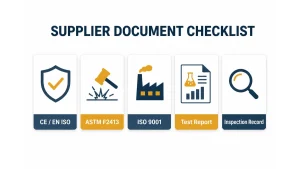
Supplier document checklist infographic showing five cards for CE / EN ISO, ASTM F2413, ISO 9001, Test Report and Inspection Record on a clean white background
-
Material Compliance and Restricted Substance Report
Safety shoes contain leather, textiles, polyurethane, rubber, glues and coatings. Different markets restrict different substances: REACH SVHC in the EU, California Proposition 65 warnings in the US, and other national chemical rules. A shoe can pass an impact test and still be rejected at customs because of what is in the material file.
The trap: a supplier claims REACH compliant without a report. That is a marketing phrase, not evidence. Ask for the substance test report covering the materials in the model, with sample identification, tested chemicals and pass or fail results.
What to check: regulation covered, materials tested (upper, sole, lining, laces, insole), laboratory name, testing date and whether the tested batch relates to your production materials.
-
Pre-Shipment Inspection Record
The four documents above deal with product design; this one deals with the actual carton on the truck. A pre-shipment inspection record shows that finished goods were sampled and checked against agreed criteria before leaving the factory. It can be produced by the supplier’s own QC team, a third-party inspection company or your agent.
The trap: no inspection record, or one that only says passed. A useful record lists sample size, defect categories, defect counts and photos. If the defect count is zero, ask how many pairs were inspected. Zero defects out of five pairs is not the same as zero defects out of a properly sized sample.
What to check: PO or model reference, inspection date, sample size and method (for example AQL level), defect counts by category and clear photos. Agree the inspection method in the purchase contract, not after the truck leaves the factory.

Close-up of hands using a magnifying glass to review a generic safety shoe test report next to a boot outsole on an inspection desk
How to Verify Without Becoming an Auditor
Two habits catch most problems. First, cross-check names on invoice, ISO 9001 certificate, test report and shipping documents; ask why when they diverge. Second, treat certificate numbers as verifiable through the notified body or laboratory. If a supplier will not help you verify, that itself is information.
And ask for the paperwork before the discount. Suppliers who prepare complete documents tend to run cleaner production; those who need three weeks to find a test report are describing their file cabinet and probably their factory floor. None of this replaces on-site audits for high-value programs, but it filters out the most common failures before a container leaves the port.
How Vitosafe Handles the Paperwork
Vitosafe manufactures safety footwear in Qingdao. We do not claim that every catalogue model is pre-certified for every market. Certification is arranged for the customer’s target market and specific model, with report and any notified body work referenced clearly.
For an order we prepare: the model-specific test report, ISO 9001 information for the manufacturing entity, material compliance documentation for the destination market, and an agreed pre-shipment inspection record. If the market needs a CE certificate and Declaration of Conformity, we align model, sample and testing with the notified body path before production, not after.
Send us the target market, the model or spec and the required documents. We will tell you what is in place, what needs to be arranged and what timeline to plan for—so paperwork is ready before payment is due.
Browse our safety shoes >https://www.vitofootwear.com/category/construction/
Ask for comparison specs and trial samples >https://www.vitofootwear.com/contact/
Sources
International Organization for Standardization: https://www.iso.org/
ASTM International: https://www.astm.org/
