



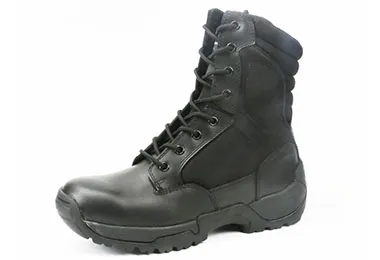

ASTM F2413 vs EN ISO 20345: The Safety Shoe Standards Guide Every Industrial Buyer Needs
You’re sourcing 500 pairs of safety shoes for your crew. The supplier sends over a spec sheet and asks: “ASTM or EN ISO?”
You freeze. Is there a difference? Does it matter? Can one pair cover both?
I’ve talked to dozens of procurement managers who learned the hard way — wrong certification means rejected shipments, OSHA fines, and worst of all, a worker getting hurt because the gear wasn’t rated for the actual hazard.
This guide breaks down both standards in plain English. No engineering degree required. By the end, you’ll know exactly what to ask your supplier, which standard your market demands, and how to avoid the traps that trip up even experienced buyers.
——————————————————————————————
Why Safety Shoe Certifications Matter (More Than You Think)
Let’s get one thing straight: a safety shoe standard isn’t a marketing badge. It’s a legal shield.
In the United States, OSHA’s rule 29 CFR 1910.136 states that employers must ensure each affected employee uses protective footwear when working in areas with foot injury hazards. OSHA defers to ASTM F2413 as the recognized standard for proving compliance.
Across the Atlantic, the EU’s PPE Regulation (EU) 2016/425 mandates that all safety footwear sold in the European Economic Area carry CE marking backed by EN ISO 20345 testing.
Here’s what happens when you get it wrong:
— Rejected shipments: Customs in the U.S. and EU will flag uncertified protective equipment. You eat the return shipping, the warehouse fees, and the delay.
— Insurance voided: If a worker gets injured wearing uncertified footwear, your liability insurance may refuse to cover the claim. You’re now personally on the hook.
— OSHA citations: Fines start around $15,000 per violation. Repeat or willful violations can hit $156,000.
I’ve seen a distributor lose a $200,000 contract because their “safety shoes” lacked the ASTM stamp the client’s safety auditor required. The shoes were well-made. They just weren’t certified. And that distinction cost them everything.
Certifications exist because someone, somewhere, already got hurt. Skipping them isn’t saving money — it’s gambling with people.
ASTM F2413 — The North American Standard, Explained
If you’re selling or buying for the U.S. market, ASTM F2413 is the name you need to know.
ASTM F2413 is a performance specification. It doesn’t dictate how to make the shoe — it sets minimum thresholds the shoe must survive.
Each protection type is tested independently. A shoe can pass impact but fail compression. A shoe can have electrical hazard protection without puncture resistance. The label tells you exactly what you’re getting.
Every certified pair has a label stitched inside the tongue. It looks something like: ASTM F2413-18 M/I/75/C/75 EH PR. Let’s decode: -18 means the 2018 revision (current active version), M is men’s sizing, I/75 and C/75 mean it passes both impact and compression at the highest level, EH is electrical hazard protection, PR is puncture-resistant midsole.
If a shoe only says “I/50” instead of “I/75,” it passed a lower impact threshold. Fine for light warehouse work. Won’t fly on a construction site. Always match the protection level to the hazard.
EN ISO 20345 — The European Standard, Demystified
If ASTM is a checklist of individual protections, EN ISO 20345 is a tiered classification system. You don’t pick individual features — you pick a rating level that bundles the protections most buyers need.
SB is the absolute minimum: 200-joule toe cap. That’s it. Light-duty indoor work. S1 adds antistatic properties, energy absorption in the heel, and a closed heel area — for dry indoor environments. S1P adds a puncture-resistant midsole at 1,100 Newtons. S2 adds water resistance — for wet indoor environments like food processing. S3 is the workhorse: S2 plus puncture resistance plus cleated outsole. Outdoor construction, heavy industry, logistics.
The jump from S2 to S3 is the most common upgrade. If your crew works anywhere that rain, mud, or sharp debris are factors, you want S3.
Beyond the base rating, optional codes appear on the label: HI (heat insulation up to 150 degrees C), CI (cold insulation down to -17 degrees C), HRO (heat-resistant outsole, 300 degrees C for 60 seconds), FO (fuel oil resistant), SRC (highest slip resistance). A typical industrial label: EN ISO 20345:2022 S3 SRC HI CI. That’s a heavy-duty waterproof boot with puncture protection, slip resistance, and thermal insulation for both hot and cold.
ASTM F2413 vs EN ISO 20345 — Head-to-Head Comparison
Here’s the side-by-side most buyers actually need:
|
Feature |
ASTM F2413 (U.S.) |
EN ISO 20345 (EU) |
|
Toe Impact Test |
75 ft-lb drop test |
200-joule impact test |
|
Compression Test |
2,500 lb static crush |
15 kN (approx 3,372 lb) |
|
Puncture Resistance |
270 lb force (PR marking) |
1,100 N (included in S1P / S3) |
|
Electrical Hazard |
EH — 18,000V protection |
Separate EN 50321 standard |
|
Slip Resistance |
Separate ASTM F2913 standard |
Built into EN ISO 20345 (SRA/SRB/SRC) |
|
Water Resistance |
Not in F2413 core standard |
Built into S2/S3 ratings |
|
Antistatic |
SD marking (separate) |
Built into S1 and above |
|
Approach |
Build-your-own: pick protections |
Tiered system: pick your level |
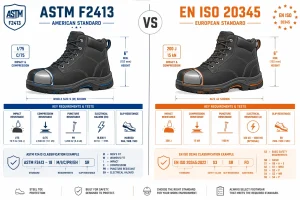
Side-by-side infographic comparing ASTM F2413 American safety footwear standard with EN ISO 20345 European standard, showing boot diagrams, key test requirements, impact and compression values, and classification codes
The big takeaway: ASTM is a build-your-own-protection menu. EN ISO is a bundled meal deal. Neither is strictly “better” — they serve different regulatory ecosystems. A shoe that crushes ASTM testing might still fail EN ISO, not because it’s inferior, but because the test methods and pass/fail criteria differ.
You cannot assume an ASTM-certified shoe will pass EN ISO testing, or vice versa. The test rigs, impact angles, and measurement tolerances are different. If you need both stamps, buy from a manufacturer who has actually tested to both standards. Anything less is wishful thinking.
Inside a Safety Shoe: What the Toe Cap Actually Protects
Let’s talk about what’s between your foot and the hazard. Once you understand the construction, the certification makes intuitive sense.
Walking through a typical S3 or I/75+C/75+PR safety boot from the outside in: the upper (full-grain leather) handles abrasion and water. The toe cap (steel, composite, or aluminum) absorbs impact and compression. The lining (breathable mesh) wicks moisture. The insole (memory foam or EVA) provides shock absorption. The midsole plate (stainless steel or Kevlar) stops punctures. The outsole (dual-density PU or nitrile rubber) delivers slip, oil, and heat resistance.
Three materials dominate the toe cap market: steel is heaviest and toughest — ideal for demolition and heavy construction. Composite (fiberglass/Kevlar/carbon) is about 30% lighter and non-conductive — perfect for airports, electricians, and cold storage. Aluminum splits the difference on weight but conducts heat and cold. Both standards test all three against the same thresholds. Your material choice affects weight, thermal behavior, and metal detectability — not certification.
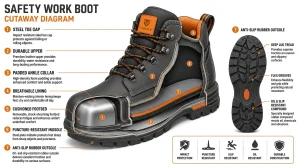
Safety work boot cutaway diagram showing internal protective layers: steel toe cap, durable leather upper, padded ankle collar, breathable lining, cushioned footbed, puncture-resistant midsole, and anti-slip rubber outsole with tread features
How to Choose the Right Standard for Your Market
Selling to North America? ASTM F2413 is non-negotiable. OSHA requires it. Check specific protection codes match your hazard assessment. For Canada, you’ll need CSA Z195 on top of or instead of ASTM — they’re not interchangeable. OSHA inspectors check markings. A missing label means a citation.
Selling to Europe, the Middle East, or Southeast Asia? EN ISO 20345 is your baseline. UK now requires UKCA marking alongside or instead of CE, post-Brexit, but the underlying standard is still BS EN ISO 20345. Australia/New Zealand uses AS/NZS 2210.3 — close to EN ISO with extra heat-resistance requirements. Middle East generally accepts CE + EN ISO, though large projects (Aramco, ADNOC) have additional specs.
One supplier who actually understands both markets — this is where working with a manufacturer who knows both ASTM and EN ISO requirements saves you real time. Instead of educating two different factories on what your market needs, you work with one team that already speaks both languages. Fewer misunderstandings, simpler communication, faster turnaround.
5 Questions to Ask Your Supplier Before You Send the PO
I’ve compiled this from watching buyers get burned:
1. Can I see your test reports from an accredited lab — not just the certificate? A certificate tells you a sample passed. Test reports tell you every batch is being checked. Look for Intertek, SGS, TUV, UL.
2. Is the certification stamp on every pair, or just the shipment documentation? ASTM requires markings inside each shoe. EN ISO requires CE mark and rating on each pair. Box-only markings are a red flag.
3. Do you hold ISO 9001 for quality management? It means documented processes for raw material inspection, in-line QC, and final audit. A manufacturer with ISO 9001 is dramatically less likely to ship you a batch where half the soles delaminate after two weeks.
4. What’s your MOQ and lead time for custom-labeled orders? Some factories need 5,000 pairs for custom tooling. Others can do 500 with heat-transfer labels. Know this upfront.
5. If I need a specific certification for my market, can you arrange testing and handle the paperwork? This separates the order-takers from the real partners. A good factory won’t stock every certification for every model — that’s not how this industry works. But they should know exactly which lab to call, how long it takes, and what documentation your customs broker will need.
——————————————————————————————
Work With a Manufacturer That Already Has Both Stamps
Here’s the bottom line: safety shoe certifications are not interchangeable, and guessing is expensive.
If you’re sourcing for the U.S. market, you need ASTM F2413. For Europe, the Middle East, and much of Asia, EN ISO 20345 is the gatekeeper. And if you’re distributing across multiple markets, you need a supplier who can deliver both — with the test reports to prove it.
That’s exactly how Vitosafe Footwear works. Based in Qingdao, China, we’ve been manufacturing safety shoes, work boots, and rain boots since 2008. We hold ISO 9001 for quality management. When a customer needs ASTM F2413 certification for the U.S. market, we arrange it. When they need CE / EN ISO 20345 for Europe, we arrange that too. We don’t pretend every pair of shoes carries every certification — that would be dishonest and expensive for you. What we do is know the labs, know the paperwork, and know exactly what your market’s customs inspector is looking for. We ship to 60+ countries. One factory, one contact person, and a production team that can build to whichever standard your order requires.
Browse our steel toe safety shoes collection > https://www.vitofootwear.com
Request certification documents and a product catalog > Contact page
Ask for a custom-labeled bulk order quote > Contact page
Your crew’s feet are worth the right paperwork. Let’s make sure you have it.
——————————————————————————————
Published by Vitosafe Footwear — Qingdao, China. Your partner in certified industrial safety footwear. Questions about standards? Reach out. We have answered them all.
