


How DESMA Direct Soling Changes the Weakest Part of a Safety Boot
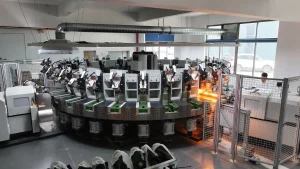
The Desma injection molding machines at our factory
Picture a representative sourcing scenario. After one hot season, a distributor hears that usable-looking boots are separating at the toe flex point. The order, climate and failure rate will differ by project. The commercial problem will not. Once a customer can pull the sole away by hand, the rest of the boot no longer matters.
That is why construction method deserves a place on the purchase specification. Buyers often compare leather thickness, toe-cap material and certification, then leave the upper-to-sole bond buried in a product photo. It is a mistake. The bond line is asked to survive thousands of flexes, water, dirt, heat and whatever chemical residue happens to be on the floor.
DESMA calls its core process direct soling: the sole is moulded onto a pre-manufactured shoe upper. Cement construction follows a different route: the upper and a separately made outsole are prepared, adhesive is applied, and the two parts are pressed together. Both methods can produce good footwear. They simply fail in different ways, demand different controls and suit different buying priorities.
Direct Soling and Cementing Are Not the Same Production Step
In a direct-soling line, the lasted upper is positioned in a mould and the sole material is introduced around it. When the process is set correctly, the sole takes shape and joins the prepared upper during the same production cycle. There is no separately finished outsole waiting at the end of a glue line.
In cement construction, workers or automated equipment prepare the upper and outsole surfaces, apply adhesive, activate it when required, align the two parts and press them together. This method gives designers enormous freedom: factories can combine many uppers with many ready-made rubber or EVA outsoles, and changing a style may require less production-line commitment.
That flexibility is why cement construction remains common. It is not inferior by definition. Proper surface preparation, compatible adhesive, controlled activation and adequate pressing can produce a reliable bond. But there are more variables: contamination, insufficient roughing, uneven adhesive or poor activation can weaken the joint before shipment.
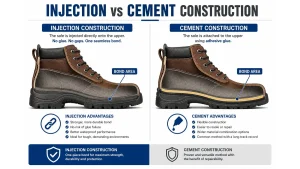
Cross-section comparison of direct injection construction and cement construction showing a moulded upper-to-sole joint versus a separate adhesive bond line
What DESMA Equipment Actually Adds
DESMA is a machinery manufacturer, not a magic quality stamp. Its equipment is widely associated with industrial direct soling, but a familiar machine name does not rescue poor material selection, dirty uppers or careless process settings. The factory still has to control preparation, dosing, mould temperature, injection parameters and cure time.
What the production system can add is repeatability. Dosing and moulding are controlled operations rather than a worker judging an adhesive film by eye. For a distributor ordering several thousand pairs, repeatability matters as much as the laboratory result on one sample. Pair 4,800 must not be the experiment.
Direct-soling platforms can also support multi-density sole structures. In practical terms, the factory may use a softer layer for cushioning and a denser wearing layer for ground contact. That is useful, but buyers should ask what material system and density combination the quoted model actually uses. ‘DESMA’ on a sales sheet does not automatically mean every sole is dual-density.
Where Durability Is Won or Lost
For cemented footwear, start at the edge. Toe flexing repeatedly tries to open the bond, and the heel can be stressed when workers kick boots off without unlacing them. Water or oil entering a poorly sealed edge makes the situation worse. When inspecting samples, flex the forefoot repeatedly, examine the perimeter under strong light and look for lifting, glue contamination or inconsistent gaps.
For directly soled footwear, a neat edge is still not enough. Look for voids, incomplete filling, excessive flash, distortion around the welt line and density variation. Cut a retained sample if the order is important enough. The outside can look clean while internal flow or adhesion is inconsistent.
Material compatibility matters in both systems. PU formulations, rubber compounds, upper coatings and release agents are not interchangeable. Water exposure, heat and chemical contact should be evaluated against the intended workplace instead of relying on the construction label alone. A directly moulded sole can still be the wrong sole for hot metal, strong solvents or prolonged hydrolysis conditions if the material itself was not selected for them.
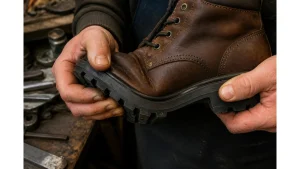
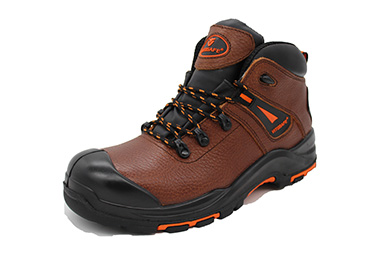
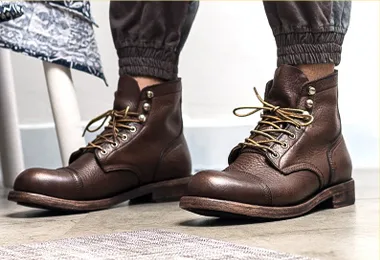
Close-up inspection of the upper-to-outsole bond on a brown leather safety boot during repeated forefoot flexing
Which Construction Should a Buyer Choose?
Choose direct soling when you expect stable volume, repeated orders and a model that must tolerate frequent flexing or wet work. It is attractive when consistent moulded geometry and a sealed upper-to-sole perimeter are priorities. The trade-off is that moulds, setup and production planning can make small experimental runs less convenient.
Choose cement construction when style flexibility, outsole variety or smaller fashion-led runs matter more. It can also be the right route when a specialised pre-made rubber outsole is required. The sensible question is not ‘Which process is always better?’ It is ‘Which process gives this model the best-controlled risk at this order volume and workplace?’
Do not let a supplier answer with a machine brand alone. Ask for the actual construction method, sole material, production control plan and relevant test records for the model being quoted.
A Procurement Checklist That Goes Beyond the Brochure
Before approving bulk production, request a construction specification that names the process and sole material. Ask whether the quoted outsole is single- or multi-density. Review an approval sample from the intended production materials, not a visually similar catalogue shoe.
Then agree on inspection points: perimeter appearance, flexing, sole hardness or density where relevant, adhesion testing method and acceptable defects. If the model is meant for wet, cold, oily or chemically exposed work, write that environment into the specification. ‘Safety boot’ is not a test condition.
Finally, keep a production sample. If complaints appear six months later, a retained sample gives both sides something useful to examine. Without it, every discussion becomes memory against memory.
How Vitosafe Approaches the Choice
Vitosafe manufactures safety footwear in Qingdao. We do not tell buyers that one construction solves every problem. We look at order volume, workplace, outsole material, target price and expected replacement cycle before recommending a route.
When direct soling fits, we can discuss mould requirements, material options, sample approval and production controls. When a cemented build is the more practical choice, we say so and focus inspection on surface preparation and adhesion. Certification is handled according to the customer’s market and model requirements; it is not assumed for every shoe in the catalogue.
Send us the job-site conditions and the model you are considering. We will explain the construction, show the relevant process controls and help you compare the real landed risk—not just the FOB price.
Sources
DESMA Schuhmaschinen GmbH: https://www.desma.de/en/
UITIC 2025 DESMA profile (direct soling and cementing definitions): https://www.uitic2025.com/front/channel/29fd16f40514196281f15ba349420e8b
