



How Long Do Safety Shoes Last? When to Replace Work Boots
A safety shoe does not become unsafe only when it looks destroyed. In many workplaces, the real problem appears earlier: the outsole has lost its grip, the midsole no longer absorbs impact, the toe area has taken a heavy hit, or the upper has opened enough to let water and dust inside. For distributors, contractors and factory buyers, replacement timing is not just a worker-comfort question. It affects accident risk, complaints, repeat orders and the way your brand is remembered after months of daily use.
There is no single lifespan for every safety shoe
A common question from buyers is simple: how long should a pair of safety shoes last? The honest answer is that there is no universal number. One worker may wear the same pair for a year in a dry warehouse. Another may damage a boot in a few months on rough concrete, steel scrap or wet construction ground. Replacement timing depends on the jobsite, walking distance, outsole material, exposure to water or chemicals, body weight, shift length and how the shoes are stored between uses.
For B2B purchasing, it is better to build an inspection routine than to promise a fixed lifespan. The question should not be, ‘Can this boot last twelve months?’ A more useful question is, ‘What signs tell us this boot should be removed from service before it creates a safety problem?’ That shift helps you manage risk without making claims the product cannot guarantee in every workplace.
Start with the outsole: grip disappears before the shoe looks old
The outsole is usually the first place to inspect. If the tread pattern has become smooth, uneven or clogged beyond cleaning, the shoe may no longer provide the traction the worker expects. This matters in warehouses, loading docks, food processing areas, maintenance shops and any place where water, dust, oil or loose material changes the floor condition.
Do not judge grip only by age. A boot used mainly on smooth indoor floors may look clean but have polished tread edges. A boot used outdoors may show missing lugs, cuts or stones trapped in the grooves. When the outsole no longer matches the original pattern well enough to bite into the floor, replacement should be considered, even if the upper still looks acceptable.
Check the toe cap area after impact or compression
Safety toe protection is designed for specific impact and compression requirements, but the shoe is not meant to absorb unlimited damage and keep working forever. If a heavy object falls on the toe area, or if the boot has been caught under equipment, the shoe should be inspected immediately. Visible dents, cracks, deformation, torn leather over the toe, or discomfort around the toe box are warning signs.
For fleet buyers, the safest policy is to replace footwear after a serious impact event rather than waiting for visible failure. A damaged toe cap may not always be obvious from the outside, especially if the upper partially springs back. When the protective structure is in doubt, the cost of replacing one pair is easier to manage than the cost of a preventable foot injury.
Watch for sole separation and upper damage
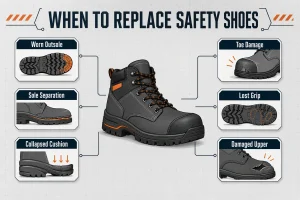
Inspection infographic showing six signs that safety shoes should be replaced
Sole separation is one of the clearest replacement signals. Small gaps at the toe flex point, heel edge or sidewall can quickly grow under moisture and bending. Once water or dust enters the gap, the problem rarely improves by itself. Temporary glue repair may make a boot look better, but it should not be treated as a reliable safety solution for demanding work.
The upper also deserves attention. Deep cuts, exposed lining, torn stitching, cracked leather, broken eyelets or a loose collar can affect fit and protection. If the shoe no longer holds the foot securely, the worker may change walking posture, lace the boot too tightly, or ignore the discomfort until it becomes a productivity and safety issue.
Comfort loss can also be a safety issue
A worn safety shoe may still look solid, but the inside can tell another story. Collapsed cushioning, flattened insoles and a tired midsole can increase fatigue during long shifts. Workers who feel pressure under the heel or forefoot may avoid certain movements or choose non-approved footwear instead. That is why comfort feedback should be included in replacement decisions, especially for teams that stand or walk all day.
This does not mean every complaint requires immediate replacement. Sometimes a different size, insole or lacing method solves the problem. But if several workers report similar fatigue on the same model after a similar use period, it may be time to review the product construction, outsole density, insole specification and expected service life.
Build a replacement routine for your team or customers
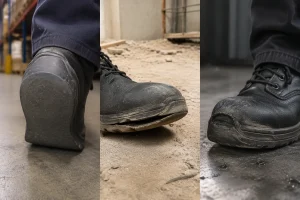
Three workplace scenes showing worn outsoles, sole separation and toe damage on safety boots
For distributors and employers, the most practical approach is a simple inspection schedule. High-risk teams may need a monthly visual check. Lower-risk indoor teams may only need quarterly checks. Ask workers to report impact events, water ingress, sole lifting, sudden loss of grip, sharp-object penetration attempts and unusual foot pain. These reports help you replace shoes before small defects become complaints.
Record the purchase date, jobsite, model, size range and main failure reason. Over time, this data becomes more useful than a generic lifespan estimate. If one jobsite consistently wears out outsoles quickly, you may need a different tread compound. If another site mainly damages uppers, the next order may need stronger leather, a scuff cap or a different boot height.
How Vitosafe helps buyers plan replacement cycles
Vitosafe does not recommend safety shoes by price alone. For private-label and bulk buyers, we look at the work environment, expected walking hours, floor condition, safety rating, outsole requirement and target market before recommending a model. The goal is not to promise that one shoe will last forever, but to help buyers choose a structure that matches the real replacement cycle of their customers.
If you are building a safety footwear line, we can help compare materials, outsole patterns, comfort features and testing requirements for your market. A clear replacement guide can also become part of your after-sales support: it teaches end users when to keep using a boot, when to inspect it closely and when to replace it without waiting for an accident.
Conclusion
The lifespan of safety shoes is not a calendar promise. It is the result of jobsite risk, materials, construction, maintenance and daily wear. Instead of relying on one fixed replacement number, buyers should inspect outsole grip, toe protection, sole bonding, upper condition and cushioning feel. Replace the shoe when protection is uncertain, not only when it looks worn out. That is the difference between buying footwear as a commodity and managing safety footwear as a working protection system.
