


Safety Shoes for Welders: What to Look for Beyond the Toe Cap
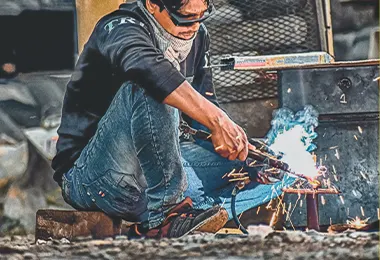
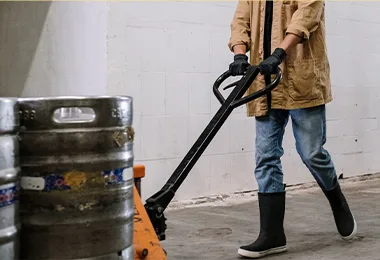
Picture a representative shop-floor scenario. A buyer orders steel toe boots for a fabrication team because the spec sheet says impact protection. Two weeks later, the welders are still wearing their old boots. Not because the new ones failed a toe-cap test. Because sparks drop through the laces, hot slag sits on the outsole, the leather dries and cracks near the vamp, and the floor around the bench is oily enough to turn a careful step into a slide.
That is the mistake: treating welding safety shoes as ordinary safety shoes with a tougher toe. A welder’s foot is not only threatened from the front. Heat comes from below, sparks fall from above, offcuts land on the instep, and the worker still has to stand, crouch and drag material for a full shift.
This guide is for procurement managers, distributors and safety officers who need boots that welders will actually keep on their feet. The toe cap matters. It is just not the whole story.
-
Start with Heat, Not the Toe Cap
Most buyers start with steel toe or composite toe. Fair enough. A welding boot still needs certified impact and compression protection. But if the worker stands near hot metal, grinding sparks or freshly cut plate, the outsole becomes the first real test.
For European-style specifications, look for HRO when heat contact with the outsole is part of the risk. HRO is commonly used to indicate an outsole tested for resistance to contact heat, often referenced around 300°C for a short exposure period in EN ISO 20345 discussions. Do not turn that into a magic promise. It does not mean the boot can sit in flame. It means the outsole compound has been considered for brief contact with hot surfaces.
For procurement, the question is simple: will the outsole soften, crack, separate or glaze over when it sees the actual shop floor? Ask what outsole material is used, whether HRO or similar heat-contact testing is available for that model, and whether the supplier has sold the same construction into metalworking environments.
-
Covered Laces Are Not Cosmetic
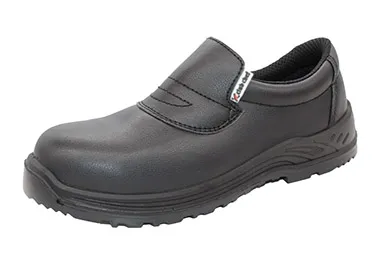
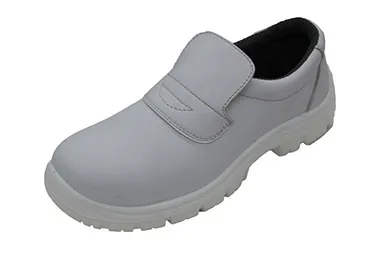
A normal lace-up boot can be a problem in welding. Sparks and slag do not politely land on the toe cap. They fall into lace channels, sit on stitching, burn synthetic threads and leave weak points exactly where the boot flexes. Once the lace fails, the worker either stops to replace it or keeps working with loose footwear. Neither is good.
That is why many welding boots use a lace cover, flap, pull-on design or protected closure. The goal is not fashion. It is to remove pockets where hot particles can collect. If your crew does overhead welding or works around cutting tables, this matters more than a glossy product photo suggests.
Ask to see the closure area from the top. If the supplier only sends a side view, request a photo showing the tongue, eyelets and stitching. On a welding boot, hidden details are often the important ones.
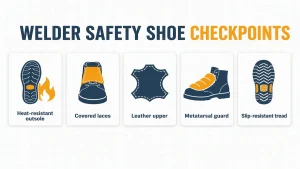
Welder safety shoe checkpoints infographic showing heat-resistant outsole, covered laces, leather upper, metatarsal guard and slip-resistant tread
-
Leather Upper Beats Pretty Synthetic Panels
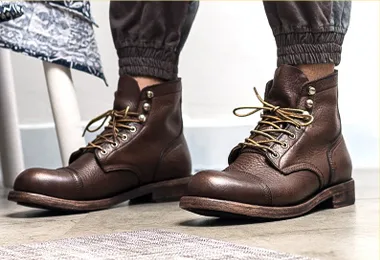
Mesh panels, soft textile collars and lightweight decorative overlays look friendly in a catalogue. In a welding bay, they can become the first parts to fail. Full-grain or corrected-grain leather is still common for welding footwear because it handles abrasion and heat splash better than many lightweight synthetic panels.
This does not mean every leather boot is good. Thin leather, poor finishing, weak stitching and badly placed seams can fail quickly. The upper should feel substantial, the vamp should not be crowded with unnecessary panels, and high-wear seams should sit away from direct spark paths when possible.
A quick buyer’s habit: ask for a close-up of the vamp, quarter and collar stitching before approving the sample. You are not checking beauty. You are checking whether the boot has too many places for heat, dust and metal fragments to start trouble.
-
Do Not Forget the Instep
A toe cap protects the front of the foot. Welding risks often land higher. Small plates, cut bars and tools drop across the instep. Hot particles collect on the top of the boot. That is why metatarsal protection appears so often in serious welding footwear.
The right choice depends on the job. A light fabrication worker who mainly tack-welds at a bench may not need the same external met guard as someone moving heavy plate in a shipyard. But the conversation should happen before purchasing, not after the first complaint.
For bulk orders, divide the crew by task. Fitters, tack welders, grinders and heavy plate workers may all share one workshop, but they do not face the same foot hazards. Buying one boot for everyone is simple. It is not always cheaper.
-
Slip Resistance Still Matters Around Welding Bays
Welding bays are rarely dry laboratory floors. There is cutting oil, coolant residue, dust, metal filings and sometimes water from cleaning. A boot that handles sparks but skates on oily concrete is not a welding boot; it is half a solution.
Ask for slip-resistance information that matches the target market. For EN ISO footwear, SRA, SRB or SRC wording may appear depending on the version and product claims. For U.S.-focused orders, ask how the outsole has been evaluated and what surface conditions were considered. The exact code matters less than the honesty of the answer and the match to your floor.
If the supplier cannot explain why a tread pattern and compound suit oily steel, wet concrete or dusty fabrication floors, they are probably selling the boot from a catalogue, not from experience.
How Vitosafe Helps Buyers Choose Welding Safety Shoes
Vitosafe does not treat welding footwear as one universal SKU. Before recommending a model, we ask about welding position, floor condition, heat exposure, required toe protection, whether metatarsal coverage is needed, and the destination market’s certification path.
If the order requires heat-contact outsole performance, a covered-lace upper, metatarsal guard, leather construction or a specific EN ISO / ASTM report, we check the model and documentation before quoting as if everything is ready. Some documents may already exist; others may need testing or arrangement for the exact model. That is the honest way to handle B2B safety footwear.
Send your welding environment, order quantity and target market. We will help you turn that into a boot specification your crew can wear and your customer can approve.
Sources
General welding footwear hazard references from public industry guidance retrieved during drafting
EN ISO 20345 HRO heat-resistant outsole references retrieved during drafting
