

You Don’t Need 5,000 Pairs to Launch Your Own Safety Shoe Brand — But You Do Need to Read This
Moses runs a small PPE distribution business out of Lagos. Three employees, a warehouse the size of a two-car garage, and a list of 40 customers who trust him because he answers WhatsApp at 11 p.m.
Last November he wired $8,700 to a factory in China for 600 pairs of private-label safety boots. His logo on the tongue. His packaging. His brand. The factory told him six weeks. At week twelve — after 47 unread WeChat messages and one very awkward phone call — the boots arrived. Wrong color on the sole. Logo crooked on half of them. And the test certificates? Never came.
Moses isn’t stupid. He’s just a small distributor who believed what the salesperson told him.
I hear versions of this story twice a month. Small distributors see the private-label opportunity — higher margins, brand ownership, customer loyalty — and they jump in without knowing which questions matter and which ones are just factory theater. This guide is what I wish Moses had read before he hit send on that wire transfer.
What ‘Private Label’ Actually Means in Safety Footwear
I need to get this out of the way because a surprising number of first-timers think private label means designing a shoe from scratch. It doesn’t.
Private label, in the real world of safety footwear manufacturing, means three things:
- You pick an existing shoe model from the factory’s catalog.
- The factory puts your logo on it — tongue label, insole print, sometimes the heel or side.
- It ships in your branded packaging.
That’s it. You’re not redesigning the outsole compound. You’re not specifying a new last shape. You’re taking a proven, certified shoe and putting your name on it.
There’s a level above this — OEM, where you actually modify the design, materials, or construction — but that requires MOQs that start at 3,000-5,000 pairs and six-figure tooling deposits. If you’re a small distributor reading this, you probably don’t need OEM yet. You need private label. And that’s good news, because the barrier to entry is lower than most factories will admit.
The factory that quotes you 5,000 MOQ for private label is either trying to scare you into a bigger order, or they’re not set up for small-batch custom branding. Either way, keep looking.
The Truth About MOQs (And Why 500 Is More Realistic Than 5,000)
Fact: most safety shoe factories in China, Vietnam, and India will tell you their MOQ for private label is 2,000-5,000 pairs. That’s their preference. Not their limit.
The actual MOQ depends on three things, in this order:
|
What Drives MOQ |
Why It Matters | Realistic Small-Run Number |
|
Logo method |
Heat-transfer labels can be done in runs of 100. Woven tongue labels need 1,000+. Embossed/embroidery needs tooling. |
100-500 pairs |
|
Packaging |
Plain brown boxes with a sticker? No MOQ. Full-color printed boxes? Usually 500-1,000 minimum print run. |
100-500 pairs |
| Factory willingness | Some factories genuinely don’t want small orders — the setup time eats their margin. Others specialize in small-brand launches. |
N/A — find the right factory |
I’ve seen factories in Qingdao and Wenzhou do 300-pair private label runs. You’ll pay a premium — maybe $1.50-2.50 extra per pair — because the factory isn’t making it up on volume. But $1.50 x 300 pairs is $450. That’s your brand-launch cost. It’s not nothing. It’s also not $30,000.
The factories that accept small MOQs for private label tend to be the ones running their own brand alongside OEM production. They understand what it’s like to start small, because they did it themselves.
If a factory quotes you 5,000 MOQ and won’t budge, ask for their ‘sample brand launch’ program. Some have one. Most don’t. The ones that do are worth their weight in polyurethane.
Lead Times Nobody Talks About Honestly
The brochure says 30-45 days. Here’s what actually happens:
|
Phase |
What’s Happening | Real Time |
| Sample confirmation (your logo) | Factory makes 1-2 pairs with your branding. You approve or request changes. This is NOT optional — skip it and Moses’s crooked-logo problem is your problem. |
7-10 days + shipping |
|
Material procurement |
If your model uses standard leather/outsole already in stock, this is fast. If you asked for something niche (navy blue full-grain? reflective piping in a specific Pantone?), add weeks. | 5-20 days |
| Production slot | The factory fits your order into their production schedule. Small orders = low priority. This is where ’45 days’ becomes ’70 days.’ |
15-30 days |
|
Production run |
Actual manufacturing. For 500 pairs, this is fast — 3-5 days of line time. | 3-5 days |
| QC + packing | In-line inspection, final audit, boxing in your branded packaging. |
2-3 days |
|
Shipping |
Sea freight: 25-35 days to most ports. Air freight: 5-7 days (but 3-4x the cost). |
5-35 days |
Real total from signed PO to boots in your warehouse: 60-75 days by sea. 45 days is possible by air if everything goes perfectly. I’ve seen it happen exactly twice in eight years.
The #1 delay I see? The logo sample approval loop. Distributor sends a PNG of their logo. Factory prints it wrong. Distributor sends feedback. Factory tries again. Three rounds later, three weeks have evaporated. Send vector files. Send a physical reference of the size you want. Be annoyingly specific.
The Margin Math — What You’ll Actually Make
Let’s talk numbers. Real ones, not the fantasy margins factory salespeople float.
Assume a mid-range S3 safety boot with composite toe, private label, 500-pair order:
|
Cost Item |
Per Pair (USD) |
|
Factory price (FOB, private label) |
$16-22 |
| Sea freight (500 pairs, split) |
$2.50-4.00 |
| Customs/duties (varies by country) |
$1.50-3.50 |
|
Warehousing + local delivery |
$1.00-2.00 |
| Your landed cost |
$21-31.50 |
|
Wholesale price to your customers |
$35-55 |
| Your gross margin per pair |
$14-23.50 |
|
Gross margin % |
40-45% |
On 500 pairs, that’s $7,000-11,750 in gross profit. Not bad. But here’s what the spreadsheet doesn’t show you:
— You’re holding inventory. 500 pairs take up space. Your garage? Full. Your cash? Tied up for months.
— Your first order won’t sell out in a week. Plan for 3-6 months to move 500 pairs unless you already have committed buyers.
— Returns happen. Defect rate on a good factory’s run is 1-2%. On a bad one, 5-8%. Budget for it.
— Repeat orders are where the money is. Order #1 covers your learning curve. Order #3 is when you start actually making money — the factory knows your specs, your logo file is already on file, and you’re not paying setup fees again.
Small distributors who make money in private label don’t order once and pray. They plan for reorder #2 before order #1 even ships.
Customization: What’s Cheap, What’s Expensive, What’s Worth It
Not all branding costs the same. Here’s the hierarchy, cheapest to most expensive:
|
Customization |
Cost Impact | Worth It For Small Distributor? |
| Heat-transfer logo on tongue | ~$0.20-0.40/pair |
Yes. Cheapest, cleanest. Lasts 6-12 months of heavy use. |
|
Woven label sewn into tongue |
~$0.30-0.60/pair + $50-100 setup | Yes. More premium look. One-time setup fee. |
| Custom insole print | ~$0.15-0.30/pair |
Yes. Cheap win. Customers notice. |
|
Branded packaging (box + tissue) |
$0.80-2.00/pair + printing plate fee | Depends. Great unboxing = social media content. But 1,000-box minimum at most printers. |
| Rubber logo patch on heel/side | $1.00-3.00/pair + mold fee ($200-500) |
Maybe. Distinctive. But the mold fee hurts on small runs. |
|
Custom outsole color |
$2.00-5.00/pair + color matching fee | Probably not. Unless your brand identity IS a specific sole color, skip it on order #1. |
| Embossed/embroidery logo | $1.50-3.00/pair + tooling ($300-800) |
Not for order #1. Looks premium, but the setup cost eats first-order profits. |
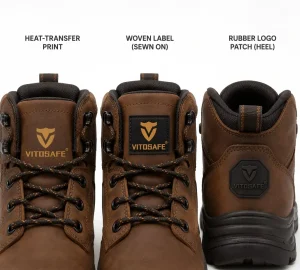
Three Vitosafe safety boots comparing logo branding methods: heat-transfer print on tongue, woven label sewn on, and rubber logo patch on heel, against white studio background
My advice to small distributors: heat-transfer tongue label, custom insole print, and a nice sticker on standard packaging. Total branding cost: under $0.70/pair. Upgrade to woven labels and custom boxes on your third order, when you know the product sells.
How to Find a Factory That Won’t Burn You
I’ve visited more safety shoe factories than I can count. Here’s what separates the ones you want to work with from the ones you don’t:
- They ask about your market before quoting a price. A good factory wants to know where you’re selling — because the certification requirements for Nigeria are different from Germany. A bad factory quotes a price immediately without asking a single question.
- They show you their existing private-label work. Ask: ‘Can you show me a brand you currently private-label for?’ If they can’t name names or show photos, they probably don’t do it regularly. You don’t want to be someone’s learning experience.
- They have in-house QC documentation, not just a certificate on the wall. Ask for a sample batch inspection report — the kind they send to existing buyers before each shipment. A factory with real QC processes has these on file. A factory that panics when you ask doesn’t.
- They communicate through one person. Not five. If your WeChat suddenly has four different factory contacts messaging you different things, that’s a factory with broken internal communication. Your order will fall through the cracks.
- They’ll do 100 pairs as a trial order — even without your branding — before you commit to 500 with your logo. This is the single best move a small distributor can make. Order a stock run first. Sell through it. Validate the market. If the boots fall apart, you’re out $2,000, not $10,000. If they sell well, you order the private-label run with confidence.
The factory that refuses a trial order is the factory that knows you won’t come back for a second.
4 Mistakes I’ve Watched Distributors Make (Don’t Be #5)
Mistake #1: Ordering the cheapest model in the catalog. ‘I’ll brand the budget boot and sell it at mid-range prices.’ Doesn’t work. Your customers aren’t stupid — they can tell the difference between a $12 boot and a $20 boot. Your brand’s first impression sticks. Make it a good one.
Mistake #2: Skipping the pre-production sample. ‘We’re in a hurry, just go straight to production.’ Every single distributor who’s said this to me has regretted it. The pre-pro sample is your last chance to catch a crooked logo, a wrong color, a missing feature — before 500 pairs exist with that exact problem.
Mistake #3: Not checking certification validity. The factory shows you a CE certificate. Great. When does it expire? Is it from an accredited lab (SGS, TUV, Intertek, UL) or an in-house ‘lab’? A certificate that expires in three months is a problem. A certificate from an unrecognized testing house is worse than no certificate at all — because it gives you false confidence.
Mistake #4: Launching without a sales plan. ‘I’ll figure out sales once the boots arrive.’ No, you won’t. You’ll have 500 pairs in your warehouse and a LinkedIn post that got 11 likes. Before you wire the deposit, know who’s buying the first 100 pairs. If you can’t name five customers ready to place orders, you’re not ready to place yours.
——————————————————————————————
You Can Do This. But Do It Smart.
Private label safety shoes aren’t some exclusive club for big distributors with deep pockets. The barrier isn’t money — 500 pairs at $20 FOB is $10,000. That’s within reach of any serious distributor. The barrier is knowing which questions to ask before you’re $10,000 deep in a factory relationship.
Find a factory that does small-run private label regularly. Ask for their existing brand clients. Run a 100-pair stock trial before you commit to branding. Send vector files, not screenshots. Budget 75 days from PO to delivery, not 45. And don’t cheap out on the boot itself — your brand isn’t your logo. Your brand is what happens when someone wears your boot for six months and it’s still comfortable.
We’ve been making safety footwear at Vitosafe since 2008. Private label is something we do every month — for distributors in West Africa, Southeast Asia, the Middle East, and South America. We’ve done runs as small as 300 pairs with heat-transfer branding. We’ll show you batch inspection reports before we ask for a deposit. And we’ll tell you honestly if the model you’re looking at will actually hold up in your market’s conditions — because a distributor who reorders is better business than a distributor who orders once and disappears.
If you’re ready to put your name on a pair of safety boots — and do it without the crooked logos, ghosted messages, and ’45 days’ that becomes 90 — reach out. Let’s talk about what you’re selling, where you’re selling it, and what it’ll take to make your first private-label order boring. Boring is good. Boring means nothing went wrong.
Browse our safety shoe cataloghttps://www.vitofootwear.com/
Ask for a private-label quote and sample lead time > Contact page
Published by Vitosafe Footwear — Qingdao, China. We make safety shoes, work boots, and rain boots for distributors who want their own brand without the headache. 60+ countries shipped. One factory. One contact person. Zero runaround.
