





Steel Toe vs Composite Toe vs Aluminum Toe: A Procurement Manager’s Honest Breakdown
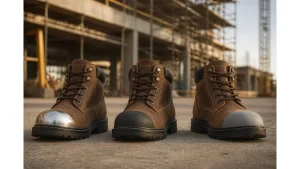
Three brown leather safety work boots in a row on construction site concrete: left with shiny steel toe cap, middle with matte black composite toe cap, right with light grey aluminum toe cap
Zhang runs a factory that needed new safety shoes for its assembly line. The PO said ‘steel toe.’ Then his most experienced worker pushed back: ‘Steel toes are heavy. Eight hours on my feet and my legs are dead by the end of shift.’
At the trade show he picked up a composite-toe sample. Lighter. Then an aluminum one. Also light. All three claim impact protection. Prices differ by almost double. He had no idea which one to buy.
This isn’t Zhang’s problem alone. I answer this question every month. So here it is, laid out plain: what actually differs between the three, who should wear which, and the people who absolutely should not buy steel. No magic. Just materials science and real working conditions.
——————————————————————————————
First, Get This Straight: All Three Toe Caps Pass the Same Tests
Steel, composite, or aluminum — they all have to pass the same impact and compression tests. ASTM F2413 demands a 75 ft-lb impact and 15 kN compression. EN ISO 20345 demands a 200-joule impact.
So on ‘will it protect your toes?’ — the three materials are equals. All of them pass. The real differences are in the experience side: weight, heat conduction, electrical conductivity.
A lot of people assume more expensive equals safer. It doesn’t. Aluminum can actually pass some tests more easily than steel because of how it absorbs energy. The price gap comes from material cost and tooling, not protection level.
On ‘will it protect your toes?’ the three materials are equals. The real differences are weight, heat, and conductivity.
Steel Toe: The Dependable Workhorse
Steel is the veteran of safety footwear. The strengths are hardcore: high strength, stable impact performance, lowest price. Same spec boot, steel runs 10-15% cheaper than composite.
The downsides are just as obvious: weight. A steel-toe boot runs 150-250 grams heavier per boot than the same model in composite. Over a shift, that weight sits on your feet. And it conducts heat — burning hot in summer sun, freezing in winter. Metal detectors? It’ll set them off.
Best for: construction sites, demolition, heavy industry, welding. Jobs where weight sensitivity is low, protection priority is high, and budget leads.
Not for: roles that need long standing or walking (assembly, picking, inspection), places with security screening, cold storage or extreme-heat environments.
Composite Toe: The Lightweight New Standard
Composite toes are made of fiberglass, Kevlar, or carbon fiber. The single biggest selling point: light. About 30% lighter than steel, 10% lighter than aluminum.
Second selling point: it doesn’t conduct heat or electricity. No hot feet in summer, no frozen toes in winter, and electricians work with less worry in live environments.
Third: it doesn’t trip metal detectors. Airports, ports, and security-strict factories — composite means no taking your shoes off every day at the gate.
The trade-off: higher price at the same protection level. And some ultra-thin composite designs don’t perform as stably as steel under extreme impacts (say, a forklift running fully over the boot). Note: extreme. For normal use, composite is plenty.
Anyone who walks a lot, passes through security, or works in hot or cold extremes should default to composite toe.
Aluminum Toe: The Overlooked Middle Ground
Aluminum has the lowest profile in the market, but it’s a serious option. Lighter than steel, cheaper than composite, strength somewhere in between.
One thing aluminum does better than composite: repeated-impact stability. In jobs with constant light impacts (moving metal parts all day), aluminum resists the slow deformation you can see in composite toes over time.
But aluminum conducts heat and electricity, and it sets off metal detectors just like steel. And its fatigue life has a limit — for truly heavy work, steel will outlast it.
Best for: general industry, mechanical maintenance, service roles. A compromise if you want lighter than steel but the composite premium stings.
Not for: heavy impact work (pick steel) or security/insulation needs (pick composite).
One Table to Decide
Here’s the comparison. Save it. Pull it up when you order:
|
Factor |
Steel | Composite | Aluminum |
| Weight | Heaviest | Lightest (~30% less than steel) |
Middle |
|
Heat conduction |
Conducts | Does not conduct | Conducts |
| Electric conduction | Conducts | Does not conduct |
Conducts |
|
Metal detector |
Triggers | Does not trigger | Triggers |
| Price | Lowest | Highest |
Middle |
|
Best for |
Construction, demolition, welding | Assembly, picking, airports, electrical, cold storage |
General industry, maintenance |
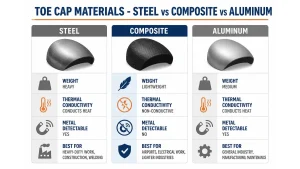
Infographic comparing toe cap materials steel vs composite vs aluminum: weight, thermal conductivity, metal detectable, and best use cases for each material
Three Myths That Cost You Money
Myth 1: ‘Composite is less safe than steel.’ At standard test levels they protect equally. Unless you work under constant extreme impact, composite is plenty.
Myth 2: ‘Aluminum is just a lightweight steel.’ It’s lighter, yes. But it conducts heat and electricity and triggers metal detectors. It’s the same category as steel, not a different one.
Myth 3: ‘The harder the toe cap, the safer it is.’ Protection comes from the energy-absorbing structure, not hardness. Check the certification (ASTM/EN ISO), don’t tap the toe with your finger and listen.
Check the certification. Don’t tap the toe with your finger and listen.
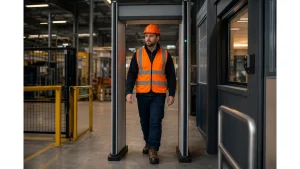
Warehouse worker in orange high-vis vest and hard hat walking through walk-through metal detector gate wearing composite toe safety boots
Three Practical Tips for Procurement Managers
- Split by role, don’t buy one shoe for the whole plant. Composite for assembly, steel for heavy work, aluminum for maintenance. One PO can carry three models — suppliers do this all the time.
- Get trial samples first. Have workers wear them for a week. Focus on weight difference. Plenty of people say ‘doesn’t matter’ — then two days in composite, they never go back to steel.
- Check certification, don’t just read ‘steel toe.’ Confirm which standard your model passes (ASTM or EN ISO), what protection level, and which lab issued the test report.
——————————————————————————————
We Make All Three, So We Can Tell You the Truth
Vitosafe runs steel, composite, and aluminum toe lines in the same factory. Here’s what we can say honestly: no toe cap is ‘best.’ Only ‘best for your role.’
Send us your job-site list and we’ll match models by scenario — weight, price, and certification parameters in a comparison table. Want trial samples? We ship them. Ask ‘will composite hold up in our environment?’ We send the test reports and real customer cases.
We’ve been making safety shoes for eighteen years. All three toe types: tested, sold, praised, and complained about. Your workers deserve boots that don’t leave their legs dead at end of shift.
Browse our steel & composite toe safety shoes >https://www.vitofootwear.com/category/construction/
Ask for comparison specs and trial samples >https://www.vitofootwear.com/contact/
——————————————————————————————
Published by Vitosafe Footwear — Qingdao, China. Safety shoes, work boots, rain boots. 60+ countries shipped. One factory, one contact person. Steel, composite, aluminum — we make them all.
