




The S1-S3 Cheat Sheet: Matching the Right EN ISO Rating to Every Job Site
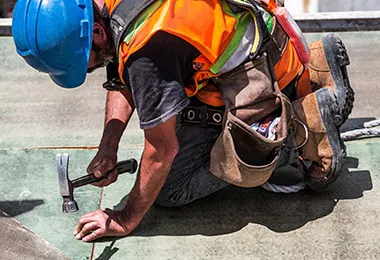
Picture a representative procurement call. A buyer sends one message: ‘We need S3 safety shoes for all workers.’ The warehouse team works indoors on polished concrete. The cleaning team handles wet floors. The outdoor crew walks through gravel, mud and scattered nails. One rating for everyone sounds efficient until the warehouse staff complain about weight, the cleaning team still gets wet socks, and the outdoor crew asks why the tread is not aggressive enough.
That is the problem with using S3 as a magic word. EN ISO ratings are not medals. They are combinations of protection features. S1, S1P, S2 and S3 each answer a different risk profile. Buy too low and you expose workers. Buy too high without thinking and you pay for features some workers do not need.
This guide gives procurement managers a practical way to match ratings to job sites without pretending that one code solves every problem.
First, What These Ratings Actually Mean
Under EN ISO safety footwear language, the base idea is simple: safety footwear starts with a protective toe cap tested for impact and compression. The S categories then add features around anti-static behaviour, energy absorption at the heel, penetration resistance, water-resistant upper materials and outsole design.
In common buyer language, S1 usually means indoor dry-work protection: toe cap, anti-static properties and heel energy absorption. S1P adds penetration resistance, so nails or sharp scrap on the floor become part of the conversation. S2 adds water penetration and absorption resistance in the upper. S3 combines the dry-work features with penetration resistance, water-resistant upper and a cleated outsole.
A note before anyone screenshots that paragraph and sends it to purchasing: standards evolve, and specific markings depend on the exact certificate and test report. Use this as a procurement map, not legal wording. Before placing an order, ask for the report tied to the model you are buying.
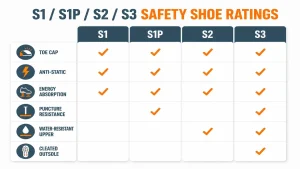
Infographic comparing S1, S1P, S2 and S3 safety shoe ratings with toe cap, anti-static, energy absorption, puncture resistance, water-resistant upper and cleated outsole features
S1: Dry Indoor Work, Not Mud and Rain
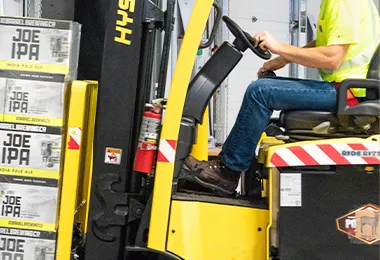
S1 is often enough for dry indoor work: assembly lines, packaging areas, light warehouses, workshops where the floor is controlled and the main hazard is impact from tools or parts. If the worker is on a clean concrete floor all day, S1 can be lighter and more comfortable than a heavy outdoor boot.
The mistake is using S1 because it is cheaper, then sending the same shoe into wet yards or nail-heavy renovation work. S1 does not exist to solve every hazard. It exists to solve a dry-floor set of hazards. That distinction saves money when used correctly and creates problems when ignored.
Good buying question: ‘Will this worker regularly step on sharp debris or wet ground?’ If the answer is no, S1 may belong on the shortlist. If the answer is yes, move on.
S1P: When the Floor Has Sharp Surprises
S1P is the quiet upgrade many buyers forget. The ‘P’ is the clue: penetration resistance. Think pallet repair, metal fabrication, light construction, maintenance rooms and recycling areas where the floor is usually dry but never perfectly clean.
If the job site has screws, cut wire, sharp scrap or pallet nails, S1P makes more sense than S1. It is not automatically a waterproof boot. It is a dry-site boot with puncture protection. That is why it can be a smart middle ground for indoor maintenance teams who do not need a full S3 build.
The detail to check is the midsole material and test reference. Some buyers care about metal inserts for familiar confidence; others prefer non-metallic inserts for flexibility and weight. Either way, do not accept ‘anti-puncture’ as a loose sentence. Ask which tested construction is used.
S2: Wet Upper Risk Without Puncture Risk
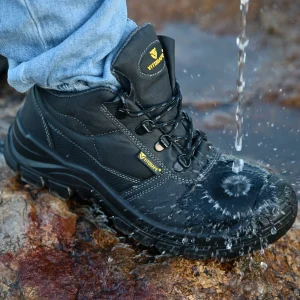
Black waterproof hiking boots being tested with running water, showing water droplets repelling off the surface.
S2 is where buyers often pause. It adds resistance to water penetration and absorption in the upper, but it is not the same as S3. The practical use case is wet indoor work where the upper gets splashed but puncture risk is low: cleaning teams, light food-adjacent areas, some facility maintenance roles, or delivery workers moving through rain but not rubble.
Do not call S2 a waterproof boot unless the documentation supports that wording. Water-resistant upper performance is not the same as whole-shoe waterproofing. If the worker stands in puddles, washes floors for hours or works outside in heavy rain, ask for the exact water-resistance claim and test report.
S2 is useful when wet exposure is real but nail penetration is not the main threat. If both water and sharp debris are present, S3 is usually the cleaner specification.
S3: The Outdoor Construction Default, But Not Always the Best Buy
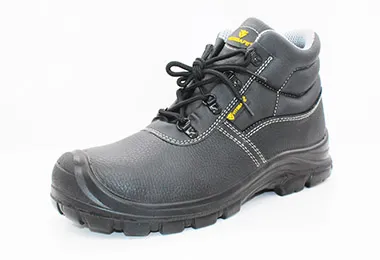
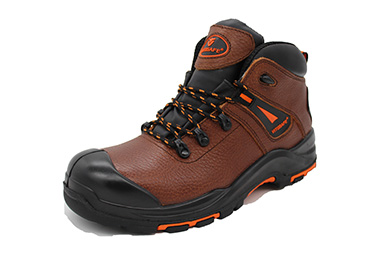
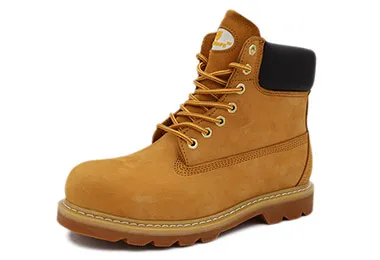
S3 is popular because it feels safe to specify. It covers the features many outdoor and construction buyers worry about: toe protection, anti-static properties, energy absorption, penetration resistance, water-resistant upper and a cleated outsole. For muddy sites, demolition, civil works, landscaping and general construction, S3 often makes sense.
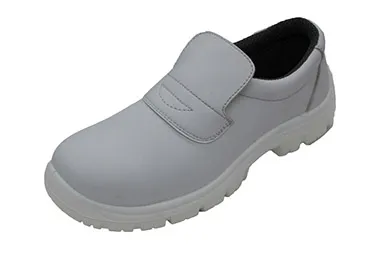
But ‘S3 for everyone’ is lazy buying. A warehouse picker on dry concrete may not appreciate the extra weight and stiffness. A worker in a food plant may need a white, washable, slip-focused design more than an aggressive mud outsole. A supervisor moving between office and shop floor may need something different again.
The point is not to avoid S3. The point is to earn it. If the worker faces wet ground, puncture hazards and uneven outdoor terrain, S3 is a strong candidate. If not, check whether S1, S1P or S2 would perform better for comfort, cost and compliance.
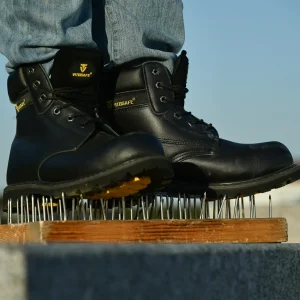
Black VITOSAFE safety boots standing directly on a wooden board full of nails, demonstrating excellent puncture-resistant and anti-smash protection.
A Simple Procurement Rule: Match the Floor First
Before asking for a price list, describe the floor. Dry indoor concrete? Start with S1. Dry but dirty floor with nails or scrap? Think S1P. Wet upper exposure without sharp debris? Look at S2. Wet, sharp and uneven outdoor conditions? S3 enters the conversation.
Then add the job-specific details: heat, oil, cold, chemicals, electrical risk, long standing hours and local certification needs. The S rating is the foundation, not the whole specification. A good supplier should ask these questions before quoting, not after the shipment arrives.
At Vitosafe, we do not treat S3 as the automatic answer. We start with the worksite, the floor, the hazards and the destination market. Some models may already have the needed reports; some require testing or documentation for the exact order. That is a slower conversation than ‘send S3 price,’ but it produces fewer wrong boots.
Sources
Public EN ISO 20345 explanatory references retrieved during drafting, including Uvex and industry safety-footwear guides
Use as procurement guidance only; final model selection should follow the actual product test report and destination-market requirements
