

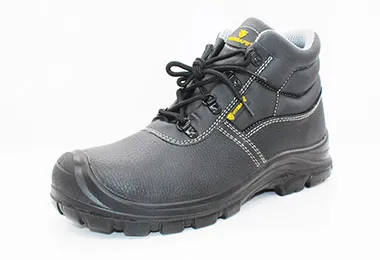

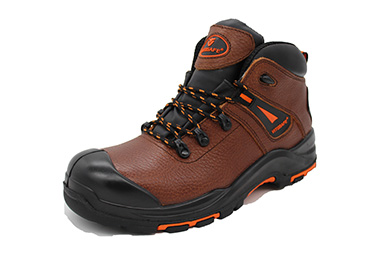
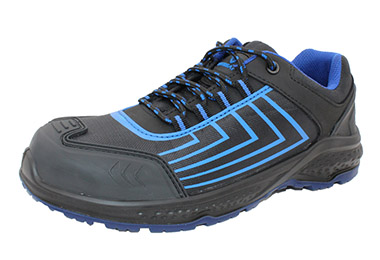

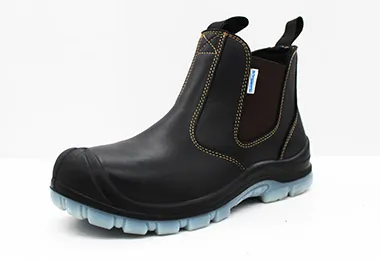
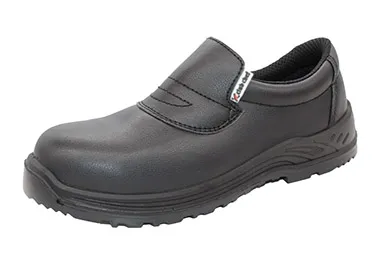

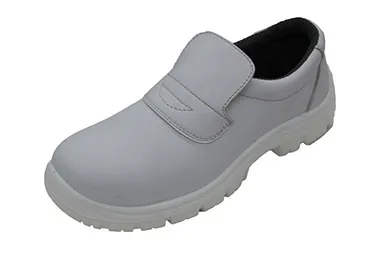
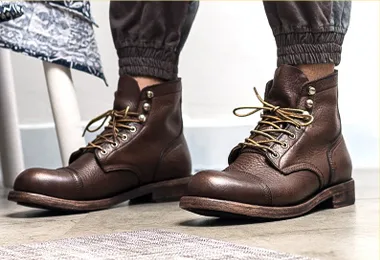
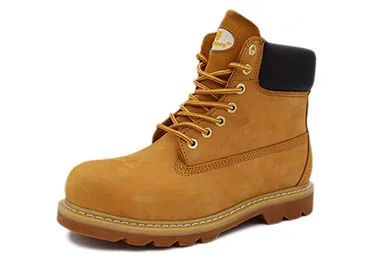
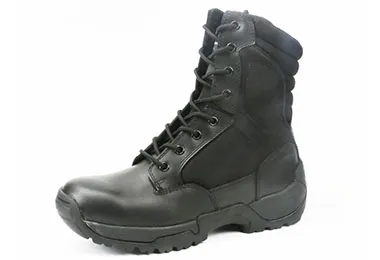

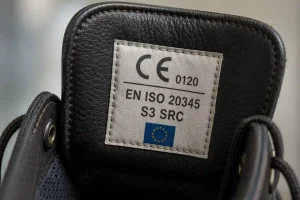
A closer look at the certification label inside a pair of safety boots — the markings that separate tested protection from empty claims.
Last month, a procurement manager in Chile sent us an email. He’d just received a container of safety shoes from another supplier — all stamped with a CE mark. The problem? His client in France rejected the shipment because the shoes failed a spot check on slip resistance. The CE mark was fake.
He lost $23,000.
I hear stories like this at least twice a month. Buyers assume the little symbols on the tongue label mean the shoes have been tested. They haven’t. The label is a declaration, not a guarantee — and in safety footwear, confusing the two gets expensive fast.
At VITOSAFE, we test over 90% of our production to four major international standards. Not because regulations force us to — but because when a worker in a German steel plant or a Canadian logging site laces up our boots, we need to know they’ll hold.
Let me walk you through what each certification actually means, what’s being tested, and how to verify the label you’re looking at is real.
The Big Three: ISO 20345, ASTM F2413, and AS/NZS 2210
Most safety footwear sold internationally falls under one of three standards. If you’re buying for multiple markets, you need to understand the differences — because a boot that passes ISO 20345 doesn’t automatically meet ASTM requirements, and vice versa.
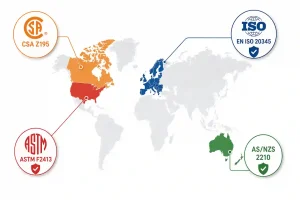
Four major certification regions — one standard doesn’t cover all markets. Know which applies to your destination country.
EN ISO 20345 (Europe)
This is the most widely recognized standard globally. If you sell into the EU, UK, Middle East, or much of Africa and Southeast Asia, your shoes need ISO 20345.
The standard classifies footwear into safety categories — these are the codes you see printed on the tongue label:
- SB: Basic safety — 200-joule toe cap protection. That’s it. No midsole, no heel energy absorption, no anti-static. Minimum viable product.
- S1: SB + anti-static + heel energy absorption + closed seat region. Think light manufacturing.
- S1P: S1 + puncture-resistant midsole (≥1,100N). Your construction-site boot.
- S2: S1 + water penetration resistance. Wet environments — food processing, outdoor work.
- S3: S2 + puncture-resistant midsole + cleated outsole. The full package. Heavy industry, construction, logistics.
On top of these base codes, manufacturers add symbol codes for additional protection. Here’s what the most common ones mean:
|
Symbol |
What It Means |
|
P |
Puncture-resistant midsole (≥1,100N) |
|
A |
Anti-static (100kΩ–1,000MΩ) |
|
HI |
Heat insulation of the sole (up to 150°C) |
|
CI |
Cold insulation of the sole (down to -17°C) |
|
E |
Heel energy absorption (≥20J) |
|
WR |
Water-resistant upper |
|
WRU |
Water-resistant upper (full shoe) |
|
M |
Metatarsal protection |
|
AN |
Ankle protection |
| CR |
Cut-resistant upper |
| SRC |
Highest slip resistance (ceramic + steel / glycerine + water) |
A label reading S3 SRC means: composite or steel toe, anti-static, heel energy absorption, water-resistant upper, puncture-resistant midsole, cleated outsole, and best-in-class slip resistance. That’s the boot you want on a rainy construction site.
What ISO 20345 Actually Tests
- Toe cap impact: 200J (a 20kg weight dropped from 1 meter)
- Toe cap compression: 15kN static pressure
- Puncture resistance: ≥1,100N — roughly equivalent to 110kg pressing on a nail tip
- Slip resistance (SRC): Coefficient of friction ≥0.36 on ceramic/NaLS, ≥0.18 on steel/glycerine
ASTM F2413 (United States)
The US does things differently. ASTM F2413, published by ASTM International, is the dominant standard for North American markets.
Unlike ISO 20345’s category system, ASTM uses a line-by-line labeling approach. Each protection feature gets its own code:
| Code | What It Means |
| I/75 | Impact-resistant toe cap (75 ft-lbs ≈ 101.7J) |
| C/75 | Compression-resistant toe cap (2,500 lbs ≈ 11.1kN) |
| Mt/75 | Metatarsal impact protection (75 ft-lbs) |
| PR | Puncture-resistant midsole (≥270 lbs ≈ 1,200N) |
| EH | Electrical hazard protection (18kV for 1 minute) |
| SD | Static dissipative (10⁶–10⁸Ω) |
| CD | Conductive (<500kΩ) |
A label reading ASTM F2413-18 M I/75 C/75 PR EH means: men’s footwear, impact and compression-rated toe cap, puncture-resistant midsole, and electrical hazard protection.
The key difference from ISO: ASTM’s toe impact threshold is lower (101.7J vs 200J), but the electrical hazard test (EH) is unique — there’s no direct ISO equivalent. If your workers deal with live circuits, ASTM EH-rated shoes are non-negotiable.
AS/NZS 2210 (Australia / New Zealand)
The Australian standard closely mirrors ISO 20345 but with some regional adjustments. The classification system is nearly identical (SB, S1, S1P, S2, S3), and the testing thresholds match ISO: 200J toe impact, 15kN compression, and ≥1,100N puncture resistance.
The main practical difference: AS/NZS 2210 requires testing by a NATA-accredited laboratory (or equivalent) in Australia/New Zealand. If you’re exporting to Oceania, your existing ISO 20345 test reports from a European notified body usually aren’t accepted — you need to re-test locally or through a recognized mutual recognition arrangement.
CSA Z195 (Canada)
Canada’s standard is similar in structure to ASTM but maintained by the Canadian Standards Association. It uses a grade system:
- Grade 1: Toe cap only (comparable to SB)
- Grade 2: Toe cap + puncture-resistant sole (comparable to S1P)
- Grade 3: Toe cap + puncture-resistant sole + metatarsal protection
CSA also mandates dielectric (electric shock) testing that differs from ASTM’s EH test — another reminder that certification is market-specific.
The CE Mark: Europe’s Gatekeeper
Here’s where most buyers get confused.
A CE mark on a safety shoe doesn’t mean the shoe passed ISO 20345. It means the manufacturer declares the shoe complies with the relevant EU regulation — in this case, Regulation (EU) 2016/425 on Personal Protective Equipment.
For safety footwear (Category II PPE), CE marking requires:
- An EU-type examination certificate issued by a notified body (e.g., CTC in France, SATRA in the UK, Ricotest in Italy)
- Ongoing factory production control (annual audits)
The certificate number should appear on or near the CE mark on the label. If you see a CE mark without a 4-digit notified body number next to it, ask questions. The number identifies which European testing body verified the product — no number, no verification.
Quick test: Ask your supplier for the EU Declaration of Conformity and the notified body’s type-examination certificate. A legitimate manufacturer can produce these within 24 hours. If they stall, walk away.
How to Read a Safety Shoe Label in 30 Seconds
Every certified safety shoe has a permanent label (usually stitched onto the tongue or printed on the lining). Here’s what to check, in order:
- Manufacturer identification — brand name or registered trademark
- Model designation — style name or number
- Size marking — EU, UK, or US size
- Standard reference — e.g., “EN ISO 20345:2022” or “ASTM F2413-18”
- Protection codes — e.g., “S3 SRC” or “I/75 C/75 PR EH”
- CE mark + notified body number (EU market) — e.g., “CE 0075”
- Month and year of manufacture — required by all standards
If any of these seven items is missing, the labeling is non-compliant. That doesn’t automatically mean the shoe is unsafe — but it means the manufacturer isn’t following the rules, and that’s rarely an isolated problem.
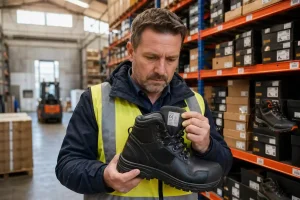
A safety officer inspecting certification labels during incoming quality control. Thirty seconds per pair can save thousands in rejected shipments.
Red Flags When Buying Certified Safety Shoes
Over 15 years in this business, here’s what I’ve learned to watch for:
- The price is too good. A pair of genuine S3-certified boots with a steel toe, puncture-resistant midsole, and SRC-rated outsole costs real money to manufacture. If someone offers you S3 boots at $6 FOB, the certification is almost certainly fake.
- The supplier can’t name their notified body. Every legitimate CE-certified manufacturer works with a specific testing lab. Ask “Which notified body issued your EU type-examination certificate?” If they pause, you have your answer.
- The label doesn’t match the test report. I’ve seen suppliers ship boots with S3 labels but test reports for SB. Sometimes it’s carelessness. Sometimes it’s deliberate. Either way, you’re not getting what you paid for.
- The certificate doesn’t list the specific model you’re buying. A certificate covers a specific product model or family. If your supplier shows you a certificate for “Model X” but you’re buying “Model Y,” that certificate is worthless for your order.
What This Means For Your Purchase
If you’re a procurement manager, safety officer, or importer, here’s the takeaway:
- Know your market’s standard. ISO 20345 for Europe, ASTM F2413 for the US, AS/NZS 2210 for Australia, CSA Z195 for Canada. Don’t assume one covers all.
- Verify, don’t trust. Before placing your order, request: the EU type-examination certificate (with notified body number), third-party test reports for the specific model you’re buying, and the manufacturer’s Declaration of Conformity.
- Look for the label. Every pair should carry a permanent, legible label with all seven elements. Spot-check a few pairs from each shipment — it takes 30 seconds per pair and can save you tens of thousands.At VITOSAFE, every style a customer orders is tested and certified to the relevant standard — whether it’s EN ISO 20345, ASTM F2413, AS/NZS 2210, or CSA Z195. All certificates are issued by accredited notified bodies, and we’re happy to share the test reports before you place your order.Because honestly? We’d rather lose a sale than ship a pair of boots we’re not confident in.
VITOSAFE is a Qingdao-based safety footwear manufacturer with over 300 employees, 2.5 million+ pairs annual output, and exports to 60+ countries. Our products are certified to EN ISO 20345, ASTM F2413, AS/NZS 2210, and CSA Z195. For bulk inquiries, reach us at Ashley@vitofootwear.com.
