




Why Your Warehouse Crew Keeps Slipping — And What the SRC Rating Actually Fixes
Two slips in one month at Marco’s warehouse. First one in receiving: water on the floor, a worker carrying two boxes lost his balance, caught himself on his wrist. Fracture. Second one at the cold-room door: condensation-slick concrete, a veteran picker went down hard. Sprained ankle, lucky it wasn’t worse.
No one died. But the insurance claim, the investigation downtime, and the mood on the floor — those don’t care about luck.
Marco’s first move: replace every pair of shoes in the building with ‘slip-resistant’ ones. Then he called me with the question every procurement manager eventually asks: ‘This SRC thing I just paid extra for — does it actually do anything?’
This one’s for everyone who runs a warehouse, manages logistics, or signs purchase orders. What SRC is. What it tests. Which ‘slip-resistant’ shoes are faking it. And how to pick a boot that actually stays under your people on wet concrete. No fluff.
——————————————————————————————
First, the Numbers: Slipping Isn’t Bad Luck, It’s Math
BLS data: slips, trips, and falls sit near the top of workplace injury causes, year after year. In 2023 the U.S. counted over 40,000 foot-related workplace injuries — a big share of them in warehousing and logistics.
Why are warehouses so bad? The floor is a stack of hazards: concrete itself isn’t high-friction, then add forklift oil drips, rainwater dragged in by trailers, cold-room condensation, dust, and packing debris. By end of shift, there’s more stuff on that floor than tread on your boots.
And warehouse workers walk far more than the average job. A picker covering 15-20 kilometers per shift is normal. More steps, more chances to hit a slick patch. It’s not superstition. It’s probability.
A picker walking 15-20 km per shift is normal. More steps, more chances to hit a slick patch. It’s not superstition. It’s probability.
What SRC Actually Tests (One Infographic Says It All)
First, kill the myth: SRC is not a generic word for ‘slip-proof.’ It’s a brutally specific test standard inside EN ISO 20345. Slip resistance has three levels, each stricter than the last.
|
Rating |
Test Surface | Test Liquid | What It Means |
|
SRA |
Ceramic tile | Water + detergent | Grips on wet tiles |
| SRB | Steel plate | Glycerin |
Grips on oily surfaces |
| SRC | Both of the above | Both of the above |
Passes the two hardest conditions |
SRA: tested only on ceramic tile, with detergent-laden water. Pass SRA and you’re okay on wet tile. SRB: tested only on steel plate, with glycerin — far slipperier than water. Pass SRB and you have grip on oily surfaces. SRC: both tests, both surfaces, both liquids. Pass and you’ve cleared the two hardest conditions.
See the difference? SRC isn’t ‘tested twice.’ It’s ‘passed the two hardest conditions.’ That’s the rating warehouses should care about — because a warehouse floor has both wet (mopping, rain, condensation) and oily (forklifts, hydraulics, lubricants) zones.
SRC isn’t ‘tested twice.’ It’s ‘passed the two hardest conditions.’
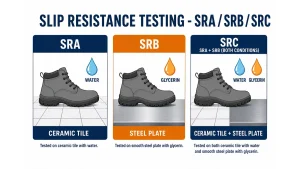
Infographic explaining slip resistance testing standards SRA SRB SRC: SRA tested on ceramic tile with water, SRB tested on steel with glycerin, SRC meets both test conditions
Why ‘Looks Slip-Resistant’ Shoes Still Slip
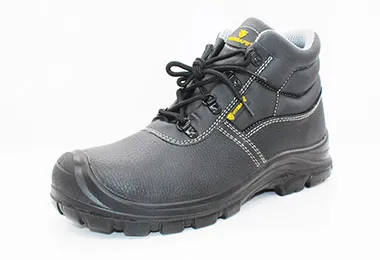
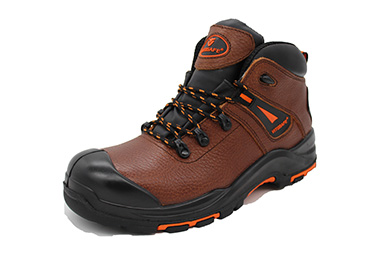
I’ve watched too many buyers judge slip resistance by staring at tread depth: ‘Deep tread = must be slip-proof.’ Deep tread helps. But what really decides grip is the rubber compound and the drainage design.
Rubber too hard? It won’t deform enough to bite the surface — like wearing clogs on ice. Rubber too soft? Poor abrasion resistance — treads wear flat in two months and the grip is gone. A good slip-resistant outsole lives at the balance point between the two.
Tread geometry matters just as much. When warehouse floor has standing water, the sole has to channel that water away so rubber actually touches concrete — that’s the drainage grooving. Whether the tread runs horizontal, vertical, or diagonal changes real-world behavior on wet floors. Another reason you can’t judge by photos alone: ask how the sole actually behaves on wet ground.
And the uncomfortable truth: plenty of ‘slip-resistant’ shoes on the market have SRC printed on the box while the actual test report is a photocopy of a three-year-old certificate. Anyone can print a label. Test reports are harder to fake.
Anyone can print a label. Test reports are harder to fake.
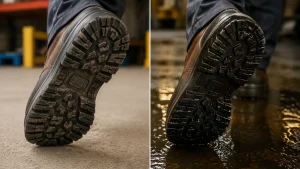
Side-by-side comparison of safety boot outsole tread on dry concrete versus wet oily surface showing slip resistance difference
Beyond SRC: What Else a Warehouse Safety Shoe Needs
SRC solves ‘staying upright.’ But a warehouse is more than one problem. Depending on your operation:
- Toe protection: receiving and picking areas have heavy loads and forklift traffic — go composite toe (lighter, non-conductive, airport-friendly) or steel. Pure sorting/packing? Less toe risk, go lightweight.
- Puncture-resistant midsole: warehouse floors collect staple guns, broken pallet nails, loose strapping. A steel or Kevlar midsole is standard for receiving and pallet-breaking roles.
- Upper material: wear-resistant microfiber or leather for general warehouse. Cold storage? You need a CI-rated cold-insulated boot — a normal shoe won’t cut it at sub-zero.
- Weight: a picker walks 15 km a day. Every 100 grams of boot weight is felt in the first two hours. Modern lightweight builds (composite toe + lightweight PU outsole) get safety boots down to around 400 grams per boot.
Three Myths That Cost You Money
Myth 1: ‘Slip resistance = deep tread.’ Tread depth is one factor. Compound and drainage design are the core. Deep tread on oily floors can trap oil — and get slipperier.
Myth 2: ‘S1/S2 rated is good enough.’ S1/S2 are EN ISO classes — slip resistance is an optional add-on. An S1 shoe can have zero slip rating. Confirm which specific test your model passed (SRA/SRB/SRC) before you order. Don’t just trust the S.
Myth 3: ‘It’s slip-proof on snow too.’ No. SRC tests tile+water and steel+glycerin. Ice and snow are a different game entirely — they need a dedicated winter compound, not a warehouse SRC sole.
S1/S2 are EN ISO classes — slip resistance is an optional add-on. Confirm which specific test your model passed. Don’t just trust the S.
The Action Checklist for Procurement Managers
- Ask your supplier for the SRC test report — not a certificate. Look for third-party labs: SGS, TUV, Intertek.
- Ask what the outsole compound is and how the drainage tread is designed. Have them send the technical spec.
- Order a trial batch of a few dozen pairs. Have workers test them two weeks on your worst zones — receiving, cold-room door. Feet tell the truth.
- Write ‘slip resistance’ into your procurement standard and require batch-level test reports on every order, not one aging certificate.
——————————————————————————————
We’ve Made Safety Shoes for 18 Years. We Take Grip Personally.
Vitosafe has been making safety footwear since 2008, and warehousing and logistics is one of the industries we serve most. Our warehouse line comes standard with SRC-rated outsoles — the compound and tread tuned for real warehouse floors: wet concrete, oil, tile. Not lab decoration.
Client wants an SGS report? We send it. Client wants trial samples? We ship them. Client asks, ‘It grips on your factory floor — will it grip by our cold-room door?’ We test both scenarios and show you the data.
Your crew deserves boots you don’t have to hold your breath over on wet floors. Get samples. Let the numbers talk.
Browse our warehouse & logistics safety shoes > https://www.vitofootwear.com/shoes
Ask for SRC test reports and trial samples > https://www.vitofootwear.com/contact/
——————————————————————————————
Published by Vitosafe Footwear — Qingdao, China. Safety shoes, work boots, rain boots. 60+ countries shipped. One factory, one contact person. Questions about slip ratings? We have tested them all.
